Nobody runs out of ideas. They run out of a way to find them, which feels identical from the inside. You sit down on a Sunday to plan the week, stare at a blank note, and conclude you have said everything you have to say about your subject. Two months in, that happens to almost everyone.
The fix is not thinking harder. It is having somewhere the ideas come from that is not your own head on a Sunday evening.
Why you dry up
Posting from memory works for about eight weeks. That is roughly how long the backlog lasts of things you already knew you wanted to say. After that, you are writing from an empty tank and it shows, because posts made under pressure drift towards the generic.
The second cause is subtler. As you get deeper into a subject, the things that still feel interesting to you get further from what a beginner needs. You stop making the posts that reach people because they bore you, and you make the advanced ones instead, which land with a small and shrinking audience.
Five sources that never run out
- Your DMs and comments. The single best source you own. Every question someone asks you is a post, and the fact they asked proves at least one person wanted it. Keep a note open and paste them in as they arrive.
- Search autocomplete. Type your topic into Instagram search, then into Google and YouTube, and read what completes. Those are real phrases real people typed. The Instagram SEO guide covers how to turn them into captions that get found.
- Your own outliers. Sort your last thirty posts by reach or by follows gained. The top three are telling you what your audience wants more of. Most creators look at this once and never act on it.
- Other people's outliers. Not their average posts, their unusual hits. Find creators in adjacent niches rather than direct competitors, look for the post that clearly outperformed everything else on the account, and work out why it did. Then make your version for your subject.
- The questions people ask before they buy. If you sell anything, or want to, the objections and hesitations people raise are content. So are the questions they ask a shop assistant, a doctor, a mechanic, whoever the equivalent is in your world.
Set up one note called "ideas" and add to it daily without judging anything. Judging is a separate job that happens on filming day.
Ten formats that work in any niche
A format is a shape you pour a topic into. Once you have ten shapes, one topic becomes ten posts.
- The specific how-to. One problem, one answer, under thirty seconds. Narrow beats broad here, always.
- The mistake list. "Five things I got wrong in my first year." Mistakes get saved, because saving feels like avoiding the mistake later.
- The comparison. This against that, with a verdict you actually commit to. People argue in the comments, and arguments are distribution.
- The before and after. Proof plus the method. The most shareable thing you own, and the hardest to fake.
- The myth. Take the thing everyone in your niche repeats and explain why it is wrong. Requires you to be right, so check first.
- The beginner question. The thing you assume is too obvious to post. It is not obvious to the people you have not reached yet, and they are most of the audience.
- The cost breakdown. What something actually costs, itemised. Money content travels in every niche there is.
- The kit. What you use and why, including the cheap option. Do this once a quarter, not once a week.
- The process. How the thing gets made, start to finish. Slow and satisfying, and it works better as a carousel than a Reel.
- The opinion. Something you believe that a chunk of your audience does not. Use sparingly and mean it.
Ten formats across even five topics is fifty posts, which is roughly three months of content. Whether they land depends on the first second, which the hook formulas guide covers in detail.
The same format across ten niches
Take the mistake list and watch it move between subjects. Nothing about it is niche-specific.
- Fitness. Five squat mistakes that hurt your knees.
- Food. Five reasons your rice keeps coming out sticky.
- Personal finance. Five things people get wrong on their first tax filing.
- Beauty. Five reasons your foundation looks patchy by lunchtime.
- Travel. Five bookings people make in the wrong order.
- Parenting. Five sleep-training mistakes that make bedtime longer.
- Fashion. Five reasons an outfit that looked good at home does not photograph.
- Tech. Five settings that are draining your battery.
- Tutoring and education. Five revision habits that feel productive and are not.
- Freelancing. Five things people get wrong in their first client contract.
Now do the same with the cost breakdown, the comparison, the myth. The grid is ten formats by however many topics your subject contains, and you will run out of weeks before you run out of squares.
If you are not sure yet which subject you are filling the grid for, choosing a niche is the more useful problem to solve first.
Build a bank, not a list
An idea list is where ideas go to die. A bank has structure, so on filming day you are picking rather than inventing.
- Capture without filtering. Every question, every autocomplete phrase, every outlier you noticed. Bad ideas cost nothing to store.
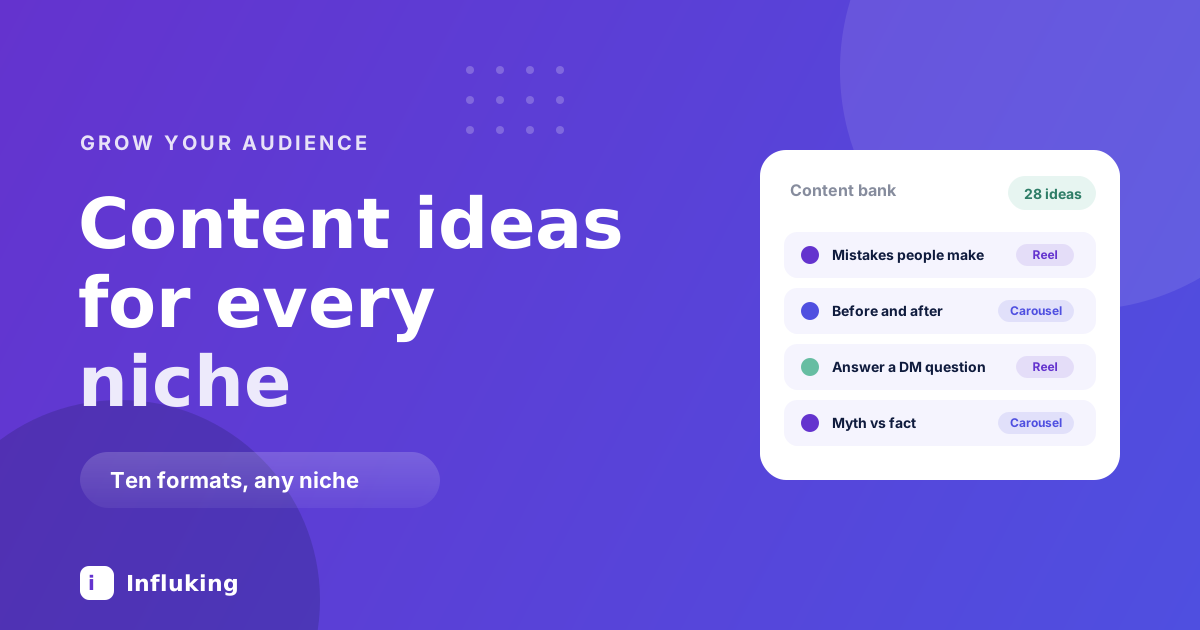
- Tag each one with a format. An idea plus a format is a shootable post. An idea on its own is still homework.
- Mark the ones you can film today. Some ideas need a location, a guest or good light. Those get scheduled. The rest are your emergency supply for a week that falls apart.
- Pull four on filming day. Batch the shooting. Deciding what to post daily is the thing that actually ends most accounts, not the filming.
Keep thirty in the bank as a working minimum. Below about ten, you start posting whatever is left rather than what is good, and your engagement rate shows it within a month.
When one works, make it a series
Most creators treat a hit as a lucky day and go back to posting whatever is next. The better move is to make the same thing again with a different subject, same opening line, same structure, numbered.
A series is what turns a viewer into a follower. Someone who enjoyed one video has no particular reason to follow. Someone who realises there is an episode four coming does. It also removes the format decision from every future post, which is most of the work.
Our guide to making viral Reels goes further into reading your own outliers and what to do in the days after one takes off.
Ideas that waste your time
- Trend chasing outside your subject. The audio is popular, the post reaches people, and none of them want what you actually make. You end up with followers who never engage again.
- Content about being a creator. Unless creators are your niche. It performs well because other creators watch it, and other creators are not your customers.
- Announcements. "Big things coming" is a post about a post. Wait and publish the thing.
- Reposting without a reason. Recycling a strong performer after a few months is sensible. Refilling a quiet week with old material your audience saw last month is not.
- Ideas that need perfect conditions. The concept that requires a studio, three people and a free Saturday will sit in your notes for a year. Make the version you can film on Tuesday.
The creators who post consistently for years are rarely the most inventive ones. They are the ones who built a system that hands them something to make on the days they have no ideas at all, which is most days. Once the bank exists, the hard part becomes the filming and the editing, and those are skills that improve with repetition rather than inspiration. When the consistency starts pulling in an audience, Influking connects creators with brands running campaigns in their category.