Almost every complaint about the Instagram algorithm comes from thinking there is one. There is not. Feed, Reels, Stories, Explore and Search each run their own ranking system, trained on different behaviour, trying to answer different questions. A post that dies in Feed can do well in Reels because two separate systems judged it on different things.
Once you see it that way, most of the advice floating around sorts itself into useful and useless very quickly.
What the systems are actually doing
Every surface is running the same basic process. It gathers a pool of candidate posts, predicts how likely you are to do certain things with each one, weights those predictions, and orders what you see. The predictions are things like: will this person watch to the end, will they send it to a friend, will they like it, will they tap the profile.
Instagram has been fairly open about this. Adam Mosseri has said repeatedly that the ranking systems are built around predicted engagement, and that different surfaces weight those predictions differently because people use them for different reasons.
The split that matters most to you is between connected reach and recommendations. Connected reach is your content shown to people who follow you, ranked mostly on your relationship with them. Recommendations are your content shown to strangers in Reels and Explore, ranked almost entirely on the content itself. Growth comes from the second one. Sales and loyalty come from the first.
Feed: relationships first
Your main feed ranks posts from accounts you follow, plus some recommended ones. The heaviest signals here are about the relationship between two accounts.
- How much you interact with that account. Whose posts you like, whose profile you visit, who you DM. This is why your closest friends and the three creators you always watch sit at the top.
- Predicted actions on this specific post. How likely you are to spend time on it, comment on it, or send it on.
- Recency. Newer posts get a boost, though the feed has not been strictly chronological for years.
- Post information. How popular it is, plus what the content is about.
The practical read: you cannot brute-force feed reach with volume. It is earned per follower, based on whether that follower engages with you. Posts that trigger replies and DMs strengthen that relationship, which lifts everything you post afterwards to that person.
Reels: the content stands alone
Reels is the recommendation engine, and it is where new followers come from. Here your existing relationship with the viewer barely matters, because most viewers do not follow you.
The signals that carry the most weight:
- Watch time and completion. Whether people finish it, and whether they watch it more than once. A short Reel watched twice is a strong signal.
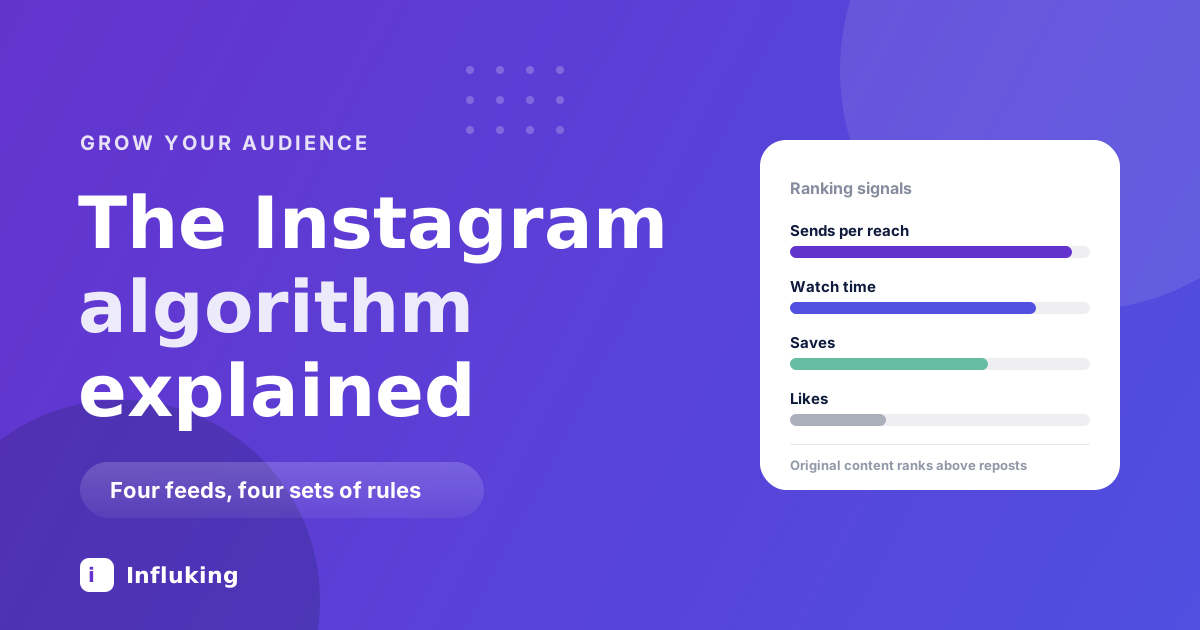
- Sends. Instagram has said publicly that sends per reach is one of the metrics they pay most attention to now. Someone putting your video into a private conversation is the highest-value action on the platform.
- Likes and comments, which still count, just less than the two above.
- Whether people who see it tap through to your profile, which is what turns reach into followers.
Because the content stands alone, the first second decides most of it. If people scroll past before the hook lands, none of the other signals ever get a chance to fire. That is the mechanical reason our Reel editing guide spends so much time on the opening frame.
Instagram has also been explicit that it favours original content over reposts, and that visibly recycled material, including videos with another platform's watermark, gets ranked below the original. Aggregator accounts that only repost other people's clips are the main target of that policy.
Stories: only for people who already care
Stories rank on viewing history, engagement history and closeness, which is a polite way of saying it shows you the people you actually pay attention to. Stories almost never bring new followers.
What they do is protect the relationship signal that Feed depends on. Replies, poll taps and question responses all tell Instagram you and that viewer are connected, which lifts your posts in their feed later. Stickers are not a growth trick, they are relationship maintenance.
Explore and Search
Explore is pure recommendation, built almost entirely from posts you do not follow. It leans on how popular a post is, how quickly it accumulated engagement, and your history with similar content.
Search has quietly become more useful. Instagram now indexes captions, on-screen text and profile fields, so writing what your video is about in plain words genuinely helps people find it. Putting your topic in your name field, not just your handle, is worth doing for exactly this reason.
Hashtags are a much weaker signal than they were. They are a mild topic hint now, not a distribution channel. Three to five relevant ones is plenty, and thirty generic ones do nothing.
What the algorithm cannot see
It does not know that you posted at 6pm because a blog told you to. It does not know your niche is competitive. It does not know you worked all weekend on that edit.
It sees behaviour. Did people stop, stay, send, save, return. Every optimisation that is not about one of those things is decoration. This is why posting time barely matters at the size most accounts are: good content gets picked up over days now, and a Reel that starts slowly can still travel a week later.
Myths worth dropping
- Shadowbanning. There is no secret punishment switch. Reach drops for ordinary reasons: content that did not hold attention, or material Instagram will not recommend, such as posts flagged as ineligible for recommendation. You can check the account status page in the app to see if anything is actually restricted.
- The algorithm hates links, or captions with the word "link", or Reels under seven seconds. None of this has ever been shown, and it keeps changing shape because it was never true in the first place.
- Engagement pods help. They generate engagement from people who do not care, so the follow-on signals like sends and profile taps never materialise, and your analytics become useless for learning anything.
- Deleting underperforming posts helps. A quiet post does not drag the account down. Deleting it only removes something that might have found an audience later.
- Posting more always means more reach. Reach is per post, based on the post. Doubling output with weaker content usually lowers your average.
How to work with it, in practice
- Hold attention in the first second. Everything downstream depends on it.
- Make things people send to someone. Ask yourself who a viewer would forward this to. If the answer is nobody, the reach ceiling is low.
- Give people a reason to save. Anything that solves a problem later gets saved, and saves push distribution.
- Post about one thing. Consistent topics let the recommendation system work out who to show you to. Mixed topics muddy the signal, which is the practical case for choosing a niche.
- Write captions in real words. They feed search, and searchable content keeps working long after the feed has moved on.
- Use Stories to keep the relationship warm, and Reels to reach people who have never heard of you.
- Reply to comments and DMs. Two-way interaction is a genuine signal, and it costs you nothing.
Read your own data instead of the theories
Your account is the only reliable source on your account. Four numbers tell you most of what you need:
- Share of reach from non-followers. Low means you are circulating inside your existing audience and growth will stall.
- Sends and saves per reach. The two strongest distribution signals, so track them as rates rather than totals.
- Retention graph. A cliff in the first three seconds is a hook problem; a slow slide is a pacing problem.
- Follows per post. Ranks your content by the only outcome that compounds.
Look at these monthly. Individual posts are noisy, and the algorithm changes often enough that any rule you memorise today will be partly wrong by next year. The behaviour it rewards, though, has been stable for a long time: people stopping, staying, and passing your work to someone else.
Once your reach is consistent, that data is also your sales pitch. Brands care far more about sends, saves and retention than follower count, which is why our rate card guide prices on views rather than followers, and why Influking matches creators to campaigns on audience fit rather than size.