Ask most creators what would change their income and they say followers. It is the obvious answer and it is only about a third right. Income is your rate multiplied by how often you get booked, minus how much work each booking takes. Followers move the first number, and they move the other two in ways nobody mentions.
Here is what earning actually looks like at each tier, and why the biggest jump in income usually happens well before the biggest jump in audience.
The tiers
- Nano: 1,000 to 10,000 followers.
- Micro: 10,000 to 50,000.
- Mid-tier: 50,000 to 500,000.
- Macro: 500,000 and above.
Different agencies draw these lines slightly differently, and the labels matter less than what changes between them.
Rate is not income
Three variables decide what you take home, and they do not move together.
Your rate rises steadily with reach. This is the part everyone tracks.
How often you get booked does not rise steadily. Nano and micro creators are hired constantly because brands run campaigns with twenty of them at once and the budget per creator is small. Macro creators are hired rarely, for large sums, in campaigns that take months to approve.
Effort per deal rises sharply. A nano deal is a DM, a product, a Reel. A macro deal is a contract, a legal review, three rounds of brand approval, a scripted shoot and an agency taking a cut.
Multiply those together and the income curve is much flatter than the rate curve.
Nano: 1,000 to 10,000 followers
Rates run roughly ₹1,000 to ₹8,000 per Reel in India, and a lot of early work is gifted rather than paid. Deal frequency is the surprising part: brands running micro campaigns need volume, so an active nano creator in a clear niche can get booked more often than they expect.
Engagement is the highest it will ever be at this tier, often several times what large accounts see, because the audience is genuinely connected to you. That is the asset you are selling, and it is why nano creators exist as a category at all.
Realistically this is side income rather than a living: a few thousand rupees a month climbing to perhaps ₹20,000 to ₹30,000 for someone consistently pitching in a good niche. The value at this stage is proof, portfolio and repeat clients rather than the money itself.
Micro: 10,000 to 50,000 followers
This is where creator income becomes real, and where the ratio of money to effort is best.
Rates run roughly ₹8,000 to ₹35,000 per Reel. Brands actively search this tier because it is the sweet spot between credible reach and affordable budget, so inbound enquiries start arriving without pitching. Engagement is still strong, which means campaign results are good, which means repeat bookings.
A micro creator with steady work might see ₹40,000 to ₹1.5 lakh a month, depending heavily on niche and how many streams they run. Crucially, deals at this tier are still simple: a brief, a shoot, one round of edits.
Per hour worked, micro creators frequently out-earn accounts ten times their size. That is the finding most people find hardest to believe until they have done both.
Mid-tier: 50,000 to 500,000 followers
Rates run roughly ₹35,000 to ₹2 lakh per deliverable. Agencies appear, campaigns get structured, and retainers become possible, which is the first time income stops being lumpy.
The trade is complexity. Contracts, usage negotiations, exclusivity clauses, approval chains. Many creators at this stage bring in help for editing or admin, which is a real cost against the higher rate.
Engagement usually falls as the audience broadens, so brands start asking harder questions about conversion rather than accepting reach at face value.
Macro: 500,000 and above
Rates start around ₹2 lakh and go up without a clear ceiling. Deals are fewer, larger and slower, often with long-term ambassador structures rather than one-off posts.
Costs rise to match: agency or management commission, an editor, sometimes a full team, plus tax and compliance overhead that nobody warns you about. Engagement rates are typically the lowest of any tier, which is why brands increasingly split the same budget across many micro creators instead.
Macro income is genuinely large, and it is also a business with staff and fixed costs rather than a person posting Reels.
The engagement paradox
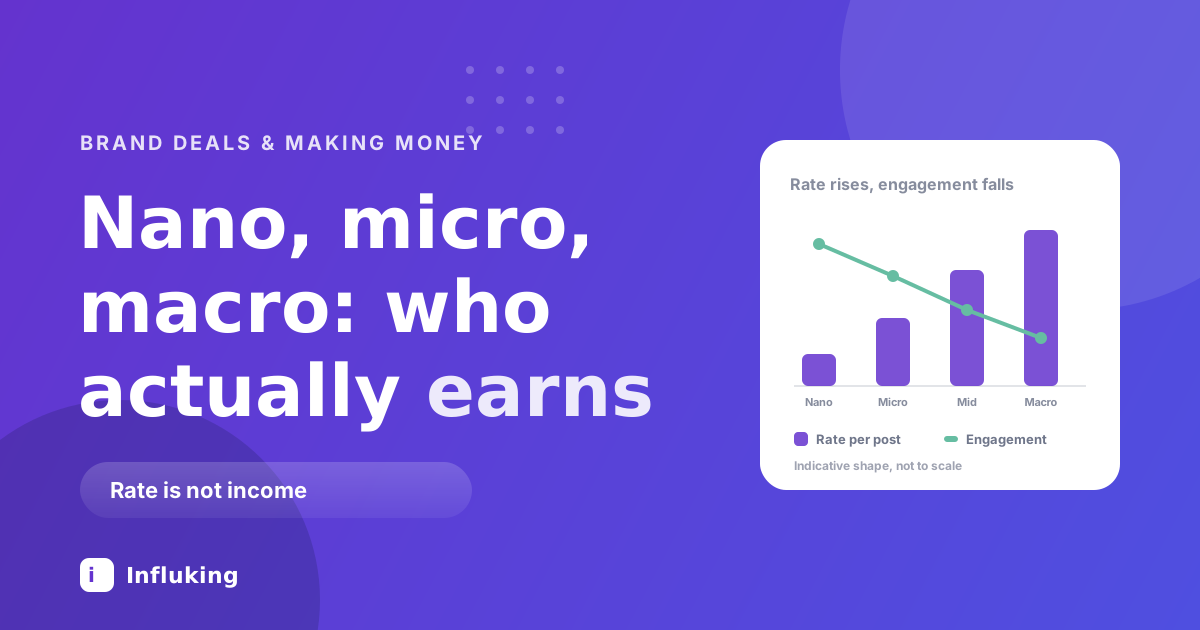
As accounts grow, rate per post goes up and engagement rate goes down. A nano creator might see 8 percent engagement and a macro creator 1 percent, so a brand paying fifty times more is not getting fifty times the reaction.
Brands worked this out some years ago, which is why so much budget moved toward nano and micro campaigns. It is also why your engagement rate is a stronger negotiating asset than your follower count, and why a smaller creator in a high-value niche can charge close to what a much larger general account gets.
Where the money comes from at each stage
- Nano: gifted collaborations, small paid posts, affiliate links, a first retainer if you are lucky.
- Micro: paid posts, repeat clients, UGC work where you make content for the brand's own channels, affiliate income, small retainers.
- Mid-tier: multi-deliverable campaigns, monthly retainers, whitelisting fees, your own digital products, event appearances.
- Macro: ambassador contracts, brand equity deals, licensing, physical product lines, speaking.
The pattern is that income diversifies before it grows. Creators who rely on a single stream have unstable income at every tier, including the top one.
What raises earnings faster than followers
- Niche. Finance, tech, B2B and luxury audiences convert into higher rates than general lifestyle at the same size. This is the biggest single multiplier available.
- Repeat clients. A brand that rebooks you three times is worth more than three brands that never return, and costs far less effort to win.
- Charging for usage rights. Most creators give these away. Reuse in paid ads is worth more than the post itself.
- Retainers. Predictable monthly income changes your business more than any single large deal.
- UGC work. Making content for brands to post themselves has no audience-size requirement at all, which makes it the fastest income route for small accounts.
The pricing mechanics behind these are in our posts on what influencers should charge and building a rate card.
When more followers stops paying
Growth pays until your audience stops being coherent. A creator who goes from 20,000 skincare followers to 200,000 general followers by chasing broad viral content often earns less, because brands no longer know who they are buying and conversion drops.
Watch engagement and conversion rather than follower count. If both fall while the number rises, the growth is costing you money.
Mistakes at every tier
- Waiting for a follower milestone to start charging. Nano creators get paid. Start pitching now.
- Pricing on followers alone. Views, engagement and niche decide value.
- Chasing growth over fit. A broad audience is worth less per head to every brand.
- One income stream. Fragile at any size.
- Ignoring effective hourly rate. A ₹2 lakh deal that consumes six weeks may pay worse than four ₹30,000 deals that take a day each.
The honest summary
Nano is where you learn and build proof. Micro is where the money-to-effort ratio peaks and most creators should aim to arrive and stay a while. Mid-tier is where it becomes a business with overheads. Macro is where it becomes a company.
Almost nobody needs 500,000 followers to earn well. A tight audience of 25,000 in a niche brands want, with repeat clients and rights priced properly, out-earns plenty of accounts with ten times the reach.
Every number here is an indicative range for the Indian market rather than a published standard, and they move with category and season. Use them to sanity-check your own position, then price on your engagement and the actual scope of the ask. To get the numbers in front of brands, start with a media kit, and Influking matches creators with brands running campaigns at every tier.