The advice to "tell more stories" is usually followed by an example from someone whose life is unusually eventful, which leaves everyone else concluding their subject does not suit it. A person posting about spreadsheets does not have a dramatic anecdote and should not go looking for one.
Story is not the anecdote. It is the shape that keeps someone watching, and the shape works on a tutorial about spreadsheets just as well as on a confession.
Why a story holds attention
Attention is held by an unresolved question. Once someone knows how a thing ends, the reason to keep watching disappears, which is why a video that gives away its answer in the first three seconds gets watched for four.
Everything below is a way of opening a question early and refusing to answer it until near the end. That is the whole mechanism. The frameworks are just reliable ways of doing it without the viewer feeling strung along.
The difference between tension and clickbait is whether the answer, when it arrives, was worth the wait.
The four beats
One structure covers most short-form content. It fits thirty seconds, and it scales up to a carousel or down to a caption.
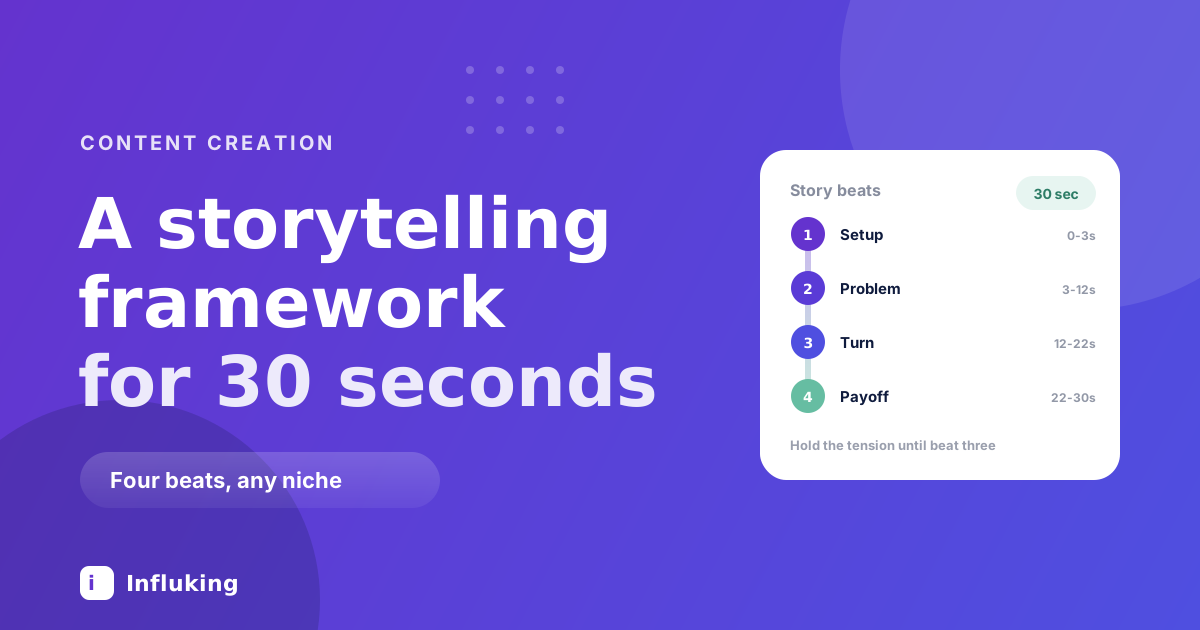
- Setup, roughly the first three seconds. Where we are and who this is for. Not your name, not your background. One line that makes the viewer think this is about them.
- Problem, to about twelve seconds. The thing that is wrong, stated in a way the viewer recognises. This is where the tension is created and it is the beat most people rush.
- Turn, to about twenty-two seconds. The insight, the method, the moment it changed. This is what they stayed for.
- Payoff, the last eight seconds or so. The result, plus what they should do with it. Short. Once the tension resolves, attention is gone anyway.
The timings are a starting shape rather than a rule. What matters is the order and the fact that beat three does not arrive early.
The same four beats across niches
Nothing here is specific to a subject.
- Fitness. Setup: you have been squatting three times a week. Problem: your knees hurt and everyone says it is form, but you filmed yourself and the form is fine. Turn: it is the shoes, and here is what to check. Payoff: swap these, retest next week.
- Personal finance. Setup: you save every month and the balance is not moving. Problem: it is not the coffee, and the budgeting apps will not tell you this. Turn: it is the three subscriptions that renew annually so you never see them. Payoff: here is how to find them in eight minutes.
- Cooking. Setup: your rice keeps coming out sticky. Problem: you rinse it, you measure it, still sticky. Turn: the water goes in cold, and the reason is the starch. Payoff: try it tonight, tell me if it worked.
- Freelancing. Setup: you sent the quote and they went quiet. Problem: chasing feels desperate and not chasing loses the job. Turn: the follow-up that works asks a question instead of asking for a decision. Payoff: here is the exact message.
Notice that none of these are anecdotes. They are a problem held open long enough to matter, then resolved.
Where each beat goes wrong
- Setup too long. The most common failure. Anything explaining who you are before the viewer cares is a reason to leave. The hook formulas guide covers earning the first second properly.
- Problem stated abstractly. "A lot of people struggle with consistency" describes nobody. "You film four Reels on Sunday and post none of them" describes someone specific, and specific is what people recognise themselves in.
- Turn arriving too early. If the answer lands at second five, the remaining twenty-five are decoration. Almost every flat video has this problem.
- Payoff that keeps going. Once the question is answered, stop. Trailing off into a summary and a follow request is where retention graphs fall off a cliff.
- No turn at all. A video that lists five things without a shift in understanding is a list. Lists can work, but they do not hold attention the same way, so they need to be genuinely useful rather than interesting.
Four variants worth knowing
The four beats are the default. These are the shapes to reach for when it does not fit.
- Attempt and result. "I tried this for thirty days." The tension is whether it worked, so the outcome has to stay hidden. Strong because the viewer wants the verdict.
- Before and after with the bridge. Show the end state early, then spend the video on how. Works when the result is visual enough to be its own hook.
- The reversal. Set up what everyone believes, then show why it is wrong. The tension is the gap between the two, and it needs you to be right or the comments will say so.
- The list with a spine. Five items, but ordered so each one raises a question the next answers, and the best one last. A list without an order is just five separate posts stacked.
Stakes are what people skip
A problem with no consequence is not a problem. "Your captions could be better" is not a reason to keep watching. "Your captions are why the post got 200 views instead of 2,000" is, because something is at risk.
You do not need drama. You need the viewer to understand what it costs them to carry on as they are. One sentence naming the cost, placed in beat two, does more for retention than any editing trick.
Specificity does the emotional work
The instinct when writing for a large audience is to broaden everything so it applies to everyone. It has the opposite effect. Broad statements apply to nobody in particular and are felt by nobody in particular.
"I lost money on a client" is a fact. "I did three weeks of work for a client who then said the brief had changed, and I had nothing in writing" is a story, and it is more relatable rather than less, because the detail is what people recognise.
The same applies to numbers. Say the actual figure. Round numbers read as invented.
Story in captions and carousels
The four beats work in text with the timings replaced by position.
In a caption, beat one is the line above the truncation point, so the setup and enough of the problem to make someone tap "more" have to happen there. The caption guide covers where that line falls.
In a carousel, slide one is the setup, slides two and three are the problem, the turn sits around slide four or five, and the last slide is the payoff. Putting the turn on slide two is the same mistake as resolving a video at second five, and it is why some carousels get a high first-slide view and almost no swipes. Format choice is covered in carousel vs Reel vs Story.
When you think you have no stories
You have the problem your audience has, and you solved it at some point. That is the whole supply.
- The thing you got wrong for a year before someone corrected you.
- The question a client or a follower asked that made you realise most people misunderstand something.
- The advice everyone in your field repeats that you have stopped believing.
- The moment a thing finally worked, and what was different that time.
Each of those is a turn, which is the hard beat. The setup and problem can be written backwards from it in two minutes. Keep them in a content bank as they occur to you, because they do not come on demand.
Checking whether it worked
The retention graph tells you which beat failed. A cliff in the first two seconds is the setup. A steady drain through the middle means the problem was not sharp enough to hold anyone. A drop right before the end means you resolved too early and the payoff was a formality.
Read it that way for a few weeks and the structure stops being a framework you apply and becomes how you think about an idea before filming. Which beat is weak is a much more useful question than whether the video was good. The editing guide covers reading the graph in detail.