This covers income tax for creators in India. GST is a separate system with separate rules, and it has its own post in GST basics.
One thing before anything else. Tax rules, rates, thresholds and limits change with every Union Budget, and your situation depends on facts this post cannot know. Treat everything here as an orientation to the concepts and the questions worth asking, then confirm the specifics with a chartered accountant before acting. A CA for a creator earning a few lakh a year costs less than most people expect and usually saves more than the fee.
Your income is business income
Money from brand deals, UGC work, affiliate commission, platform payouts and consulting is treated as income from business or profession, not as salary. That has three consequences worth understanding.
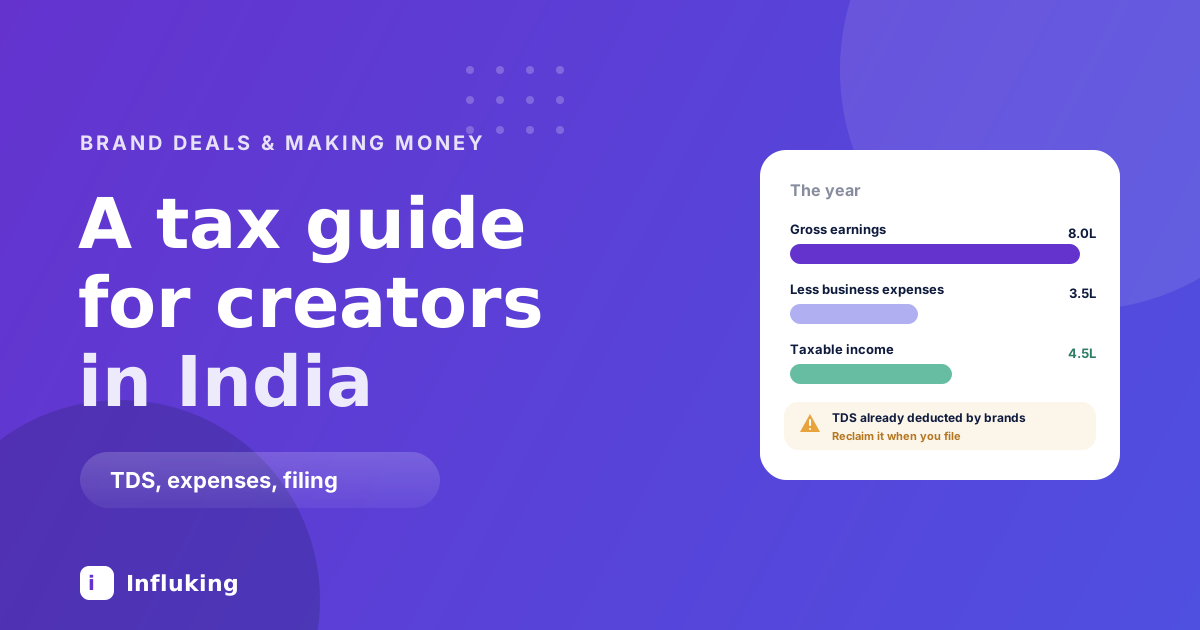
You can deduct the costs of earning it, which salaried people largely cannot. You are responsible for paying tax through the year rather than having it deducted monthly. And you file a different return form.
Gifted products are not automatically free of tax either. Where a brand sends goods in exchange for promotion, the value can be treated as a benefit connected to your profession. If you retain expensive items received for work, ask a CA how to treat them rather than assuming they are outside the system.
TDS: why the payment is smaller than the invoice
Brands deduct tax at source before paying you and deposit it against your PAN. So a ₹50,000 invoice arrives as less than ₹50,000, with the difference sitting with the government in your name.
This is not a cost. It is a prepayment of your tax, and you reclaim it when you file. If your final liability is lower than the total TDS deducted across the year, you get a refund.
Two practical points. Give brands your correct PAN, because deduction happens at a much higher rate without one. And check your Form 26AS and Annual Information Statement on the income tax portal, which show what has actually been deposited against your PAN. If a brand deducted TDS but never deposited it, you find out there, and you want to find out before filing rather than after.
Record the TDS on each payment as it arrives, which is far easier than reconstructing it in July. The invoicing guide covers the record-keeping habit.
What you can deduct
Anything genuinely used to earn the income. Where something is used partly personally, claim the business proportion rather than the whole thing.
- Equipment. Camera, phone, lights, microphone, tripod, laptop. Larger items are typically capitalised and depreciated over time rather than deducted in full in year one, which a CA will handle.
- Software and subscriptions. Editing apps, design tools, scheduling, cloud storage, stock music.
- Internet and phone. The business proportion.
- Props and products bought for content. If you bought it to film it, it is a cost.
- Travel for shoots and meetings. Not personal travel you happened to post about.
- Payments to others. Editors, photographers, assistants, agency commission.
- Professional fees. Your CA, legal advice on contracts.
- Home office. A proportion of rent and electricity where a defined space is used for work.
- Advertising and promotion. Boosted posts, website hosting, domain.
Keep the invoice for everything. A bank statement line is weaker evidence than a bill, and claims without documentation are what create problems in a scrutiny.
Presumptive taxation
India offers a simplified scheme where, instead of tracking every expense, you declare a fixed percentage of receipts as profit and pay tax on that. There are separate provisions for professionals and for businesses, with different deemed-profit percentages and different turnover limits, and those limits have been revised several times in recent years.
It is genuinely simpler and can be favourable if your actual expenses are low. It is worse if your expenses are high, because you cannot claim them on top. There are also conditions and lock-in rules about switching between schemes.
Whether you qualify, which provision applies to creator income, and whether it benefits you are exactly the questions to put to a CA, because the answer depends on your numbers and on the current year's limits.
Advance tax
If your total tax liability for the year exceeds a threshold, you are expected to pay it in instalments through the year rather than in one payment at filing. Missing the instalments attracts interest.
This catches new creators regularly, because a first good year produces a tax bill nobody budgeted for. A workable habit is moving a fixed percentage of every payment received into a separate account and not touching it. Whatever the correct percentage turns out to be for you, having the money set aside makes the instalments a transfer rather than a crisis.
Records to keep
- Every invoice you issued, numbered sequentially.
- Every bill for anything you claim as an expense.
- Bank statements for the account income lands in.
- Contracts and email agreements.
- TDS deducted per payment, reconciled against Form 26AS.
- A record of gifted products with an approximate value.
Use a separate bank account for creator income. It is the single change that makes everything else easier, because it turns "which of these 400 transactions was business" into a solved problem.
Foreign brands
Payments from brands outside India bring their own considerations, including how the income is reported, whether foreign tax has been withheld, and the paperwork your bank requires for inward remittances. Income earned from abroad is still taxable in India if you are a resident. If you work with international brands, mention it to your CA specifically rather than assuming it is treated identically.
Mistakes that cost money
- Not claiming expenses. Creators routinely pay tax on gross receipts because they never tracked costs.
- Mixing personal and business accounts. Makes claims hard to evidence.
- Ignoring TDS already deducted. That is your money and it is only recovered by filing.
- Not checking Form 26AS. Brands sometimes deduct and do not deposit.
- Assuming barter is invisible. Ask rather than assume.
- Spending the full payment. Some of it was never yours.
- Filing without help in the first year. The first return sets the pattern for everything after.
The habits that matter are unremarkable: a separate account, an invoice for every expense, TDS noted as it happens, and a percentage set aside. Do those four and the annual conversation with your accountant takes an hour instead of a weekend. Everything specific, from which scheme suits you to which form to file, belongs with someone who can see your actual numbers and the current year's rules.