Every answer to this question is someone's schedule presented as a law. Post daily. Post three times a day. Post twice a week but make it count. All of them worked for the person saying it, which is not the same as being true.
The number that matters is the highest one you can hold for a year without the quality dropping. For most people that is lower than they think and steadier than they manage.
The short answer, by format
Different surfaces do different jobs, so they get different cadences.
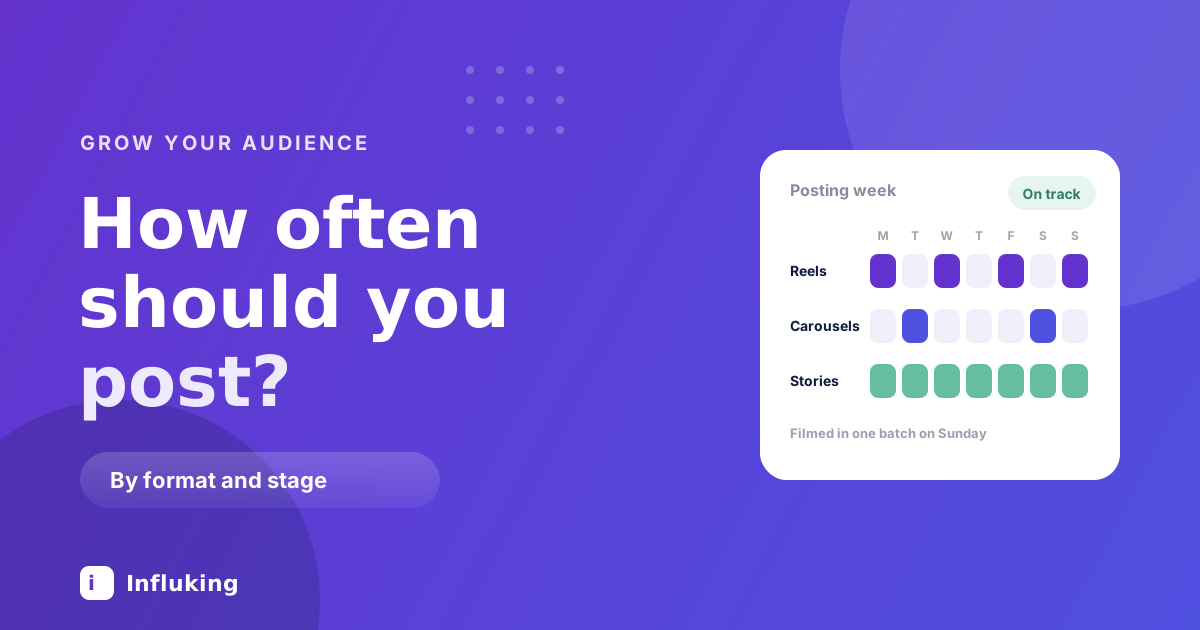
- Reels: three to five a week. This is your reach engine, so it gets the most effort. Below three, you are not giving the algorithm enough attempts to find your audience. Above five, quality usually starts slipping unless this is your full-time job.
- Carousels: one to two a week. These earn saves rather than reach. One good carousel outperforms four thin ones, and they take longer to make than people expect.
- Stories: most days, two or three frames. Not for growth. Stories hold the audience you already have and generate interactions cheaply, which the engagement guide goes into.
- Feed photos: whenever you have one worth posting. They reach almost nobody new now. Post them because they suit the moment, not to hit a quota.
Four Reels, one carousel and Stories on most days is a realistic week for someone doing this alongside a job. That is the shape to aim at before you optimise anything else.
Why more stops helping
Posting more feels like it should scale linearly. It does not, for three separate reasons.
The first is arithmetic. Your engagement rate is an average, so a post that lands flat pulls the whole account down. Six posts where two are filler performs worse than four that all earned their place, because the two weak ones drag the mean and teach Instagram to show the next one to fewer people.
The second is attention. Your existing followers see a limited number of your posts. Publishing twice a day mostly means your posts compete with each other for the same slots rather than getting new ones.
The third is you. Almost nobody who commits to daily posting is still doing it four months later, and the crash is worse than the gap would have been. A cadence you resent is a cadence you will abandon.
The floor
There is a level below which nothing compounds. Roughly two posts a week is where the account stops building momentum: the algorithm has too little recent material to test, your audience forgets the account exists between posts, and you never gather enough data to work out what is working.
One post a week is a hobby, which is a completely legitimate thing to have. It is just not a growth strategy, and expecting growth from it is where the frustration comes from.
The ceiling
Past roughly one post a day, extra volume stops paying for itself for most accounts. You are competing with yourself for the same audience slots, and the effort per post has to drop for the maths to work.
Two genuine exceptions. Accounts where the content is fast to make by nature, like a page posting single-image observations, can run high volume without quality loss. And a short sprint, three or four weeks of higher output while testing formats, can be worth it precisely because it generates data quickly. Sprints are a tool. They are not a schedule.
Frequency by stage
- Starting out, under 1,000. Post more than feels comfortable, four or five Reels a week, because you are searching for a format that works and every post is an experiment. Quality matters less than iteration speed here. This is covered in the first 1,000 followers guide.
- Between 1,000 and 10,000. Four a week, with the effort shifting from quantity to hooks and structure. You now know roughly what works, so the job is doing it better rather than trying more things. The 10,000 followers guide covers what changes at this stage.
- Above 10,000. Three or four strong posts beat six average ones, because your reach per post is high enough that a weak one costs you real distribution. Volume matters less than it did.
The pattern is that early accounts should optimise for learning and established ones for quality.
Consistency beats volume, and here is why
This gets repeated as a slogan without the mechanism, so it sounds like motivation rather than advice.
Instagram is deciding, on every post, who to test it on. That decision uses recent performance. An account posting four times a week gives the system a steady stream of signals, so it gets progressively better at finding the right audience. An account that posts eleven times in a week and then nothing for three weeks resets that process each time, and the first post after a gap performs worse because there is less recent data to work from.
There is no penalty for the gap itself, which is a separate myth covered in mistakes that kill reach. The cost is the lost momentum, not a punishment.
Batching is what makes the number achievable
The thing that ends most accounts is not filming. It is deciding what to post, every day, forever.
Film four Reels in one session. Editing four in a row takes noticeably less time than editing four on four different days, because you stay inside the same settings, the same lighting and the same head. The editing guide covers the workflow.
Then keep a bank of ideas so filming day starts with picking rather than inventing. Thirty ideas in a note is the difference between a sustainable four a week and a panicked one. That system is in the content ideas post.
When you cannot keep up
Every schedule meets a week that breaks it. Have a plan that is not "post nothing" or "post rubbish".
- Drop to your floor, not to zero. Two posts is a bad week. Zero posts becomes a bad month.
- Repost a strong performer. Most of your audience never saw it, and a Reel that worked once usually works again a few months later.
- Keep Stories going. They cost a minute and they hold the audience while the feed is quiet.
- Do not announce the break. A post about not posting is still a post, and a worse one than the repost would have been.
Myths worth dropping
- You have to post daily. Daily is one valid schedule among several, and it is the hardest to sustain. Four a week held for a year beats daily for six weeks.
- Posting twice a day doubles your reach. It splits it, since the two posts largely compete for the same audience.
- The algorithm punishes you for taking a break. No gap penalty exists. Reach falls because less recent content is circulating.
- Deleting a slow post protects your average. It discards signals the post had gathered, and Reels are often picked up days later.
- There is a universal correct number. Format, niche and how long each post takes you all change the answer.
Finding your own number
- Work out how long one good post actually takes you, start to finish, including the thinking. Most people underestimate this by half.
- Decide how many hours a week you will genuinely give this on a bad week, not a good one.
- Divide. That is your real cadence, and it is the one to commit to.
- Hold it for eight weeks without changing anything else, then check whether reach per post and saves are rising or falling.
- If quality is holding and you have spare capacity, add one post a week and watch the same numbers. If they drop, you found your ceiling.
Frequency is the variable people obsess over because it is easy to change. Which posts you make matters more, and so does whether anyone stays past the first second. Timing matters least of all, which the best time to post guide covers in detail. Pick a number you can hold, then spend the attention you were giving the schedule on the posts themselves.