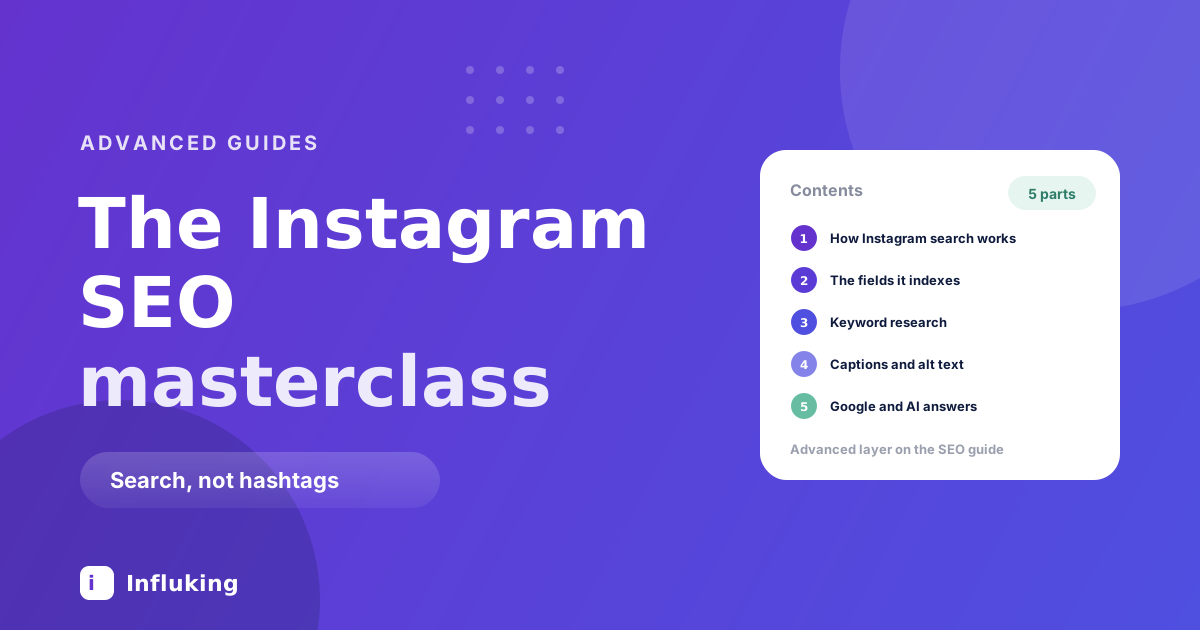
The Instagram SEO guide covers the fundamentals: which fields are indexed, how to write the name field and bio, and why searchable captions replaced hashtags. Read that first, because this assumes it.
This is the layer above. How the surfaces differ, how to research terms rather than guess them, and where Instagram content shows up outside Instagram.
Search is not one system
People treat Instagram search as a single index. It behaves as several, and content optimised for one surface does not automatically rank on another.
- Account search. Matches handles and the name field. This is why the name field is the highest-value real estate on your profile, and why putting your legal name there rather than your subject costs you constantly.
- Keyword search on content. Matches caption text, on-screen text and transcribed audio. This is the one that grew.
- Explore. Not search at all, but topic-matching driven by interaction history. It reads the same signals to decide what your content is about.
- Audio and effects pages. A separate discovery path most creators ignore entirely.
The practical consequence: a Reel can rank for a phrase while your account ranks for nothing, or the reverse. They are optimised separately.
Instagram reads more than your caption
Three inputs matter beyond the caption text.
Spoken audio. Say the topic out loud, early. A Reel where the phrase is only on screen misses a signal that a Reel saying it aloud captures. This is the single most underused SEO action available.
On-screen text. Read as text, which means your cover text and captions are doing double duty as both design and index entries.
Alt text. Manual alt text on feed posts beats the auto-generated version, and takes fifteen seconds.
Keyword research without guessing
Most creators pick phrases they would use rather than phrases their audience types. Four free sources fix that.
- Instagram search autocomplete. Type a partial phrase and read what completes. Those are real queries with volume.
- Google and YouTube autocomplete. Broader, and often reveals the question form people actually use.
- Your own DMs and comments. The exact wording of a real question, which is worth more than any tool.
- Competitor captions that rank. Search a term, look at what appears, and read how those captions are worded.
Prefer the phrase with intent over the phrase with volume. "How to fix patchy foundation" converts better than "makeup" ever will, and you can realistically rank for it.
Writing for search without sounding like it
The failure mode is a caption stuffed with terms that reads like a robot wrote it, which costs you the humans while chasing the index.
Put the phrase naturally in the first line, say it aloud in the video, and use it once more in the body if it fits. That is enough. The caption guide covers the first line, which has to work as a hook and as an index entry simultaneously.
Hashtags are a weak topic hint now, not a ranking lever. Three to five specific ones matching the actual subject, per the hashtags guide. Mismatched tags actively confuse the model of what your account covers.
Ranking outside Instagram
Public Instagram content can surface in Google results, which is a meaningful traffic source creators ignore because it is invisible in Insights.
What helps: a descriptive first line rather than a clever one, since that is what gets excerpted; a professional account with a complete profile; and consistent subject matter, because Google evaluates the account as a whole.
What does not: anything behind a private account, or a caption whose first line is an emoji.
The layer that is changing
A growing share of the questions people used to type into a search box now go to AI assistants, which answer directly rather than returning links. That shifts what visibility means.
Two things follow. Being the clearest, most specific answer to a defined question matters more than ranking for a broad term, because assistants synthesise from sources that state things plainly. And being cited across places that get read matters more than any single platform, which is an argument for the same content existing as a post, a carousel and a page you control.
This is moving quickly and anyone claiming certainty about it is guessing. The durable version is unchanged: answer real questions specifically, in plain language, consistently, on one subject.
Measuring it
Instagram does not report search rankings, so measure proxies. Track the share of reach coming from search and Explore per post, which appears in the per-post insight breakdown. Track profile visits from non-follower reach. And search your target phrases manually every few weeks to see whether you appear.
Set this up alongside the rest of your numbers in the analytics dashboard, because SEO gains arrive slowly and are invisible without a baseline.
The compounding argument
A Reel optimised for a phrase keeps being found for months, which is the opposite of a trend post that dies in a week. That makes SEO the highest-leverage thing in this guide for anyone who plans to keep going for a year.
It also pairs directly with affiliate income, which depends entirely on old content still being discovered.
A working routine
- Pick one phrase per post from autocomplete or your own DMs before filming.
- Say it aloud in the first five seconds.
- Put it on screen in the opening frame.
- Open the caption with it, written naturally.
- Three to five specific hashtags that match the subject.
- Add manual alt text on feed posts.
- Once a month, check which phrases you now appear for and make more about the ones that worked.
Nothing here is complicated and all of it is slow. The accounts that get found in six months are the ones doing this now on posts that look, today, like they did not work.