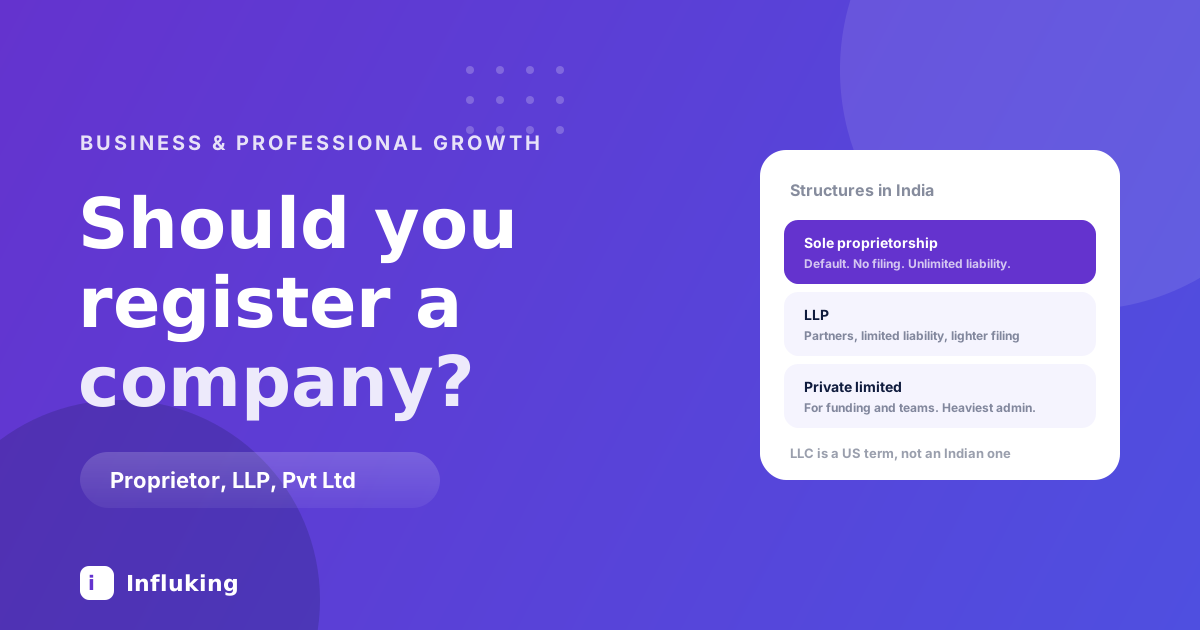
Creators searching for how to set up an LLC have usually been reading American advice. The LLC is a United States structure and has no direct Indian equivalent, so the question to ask instead is which Indian structure fits.
Before any of it: this is an orientation to the options and the questions worth asking, not advice. Company law, tax treatment and compliance requirements change, and the right answer depends on your income, your risk and your plans. Confirm with a chartered accountant or company secretary before registering anything, and expect the conversation to cost less than getting it wrong.
You already have a structure
If you earn as a creator in India without registering anything, you are operating as a sole proprietor. That is a real, legal way to run a business. You invoice in your own name, income is taxed as your income, and there is no separate entity.
This is the right answer for most creators for a long time. It has no registration cost, no annual filing beyond your own tax return, and no compliance burden. What it does not give you is any separation between you and the business, which is the main reason people eventually move.
The options
- Sole proprietorship. The default. Simplest, cheapest, and you are personally liable for everything the business does. You can still open a current account in a business name and register for GST.
- Limited liability partnership. Requires at least two partners. Gives limited liability with lighter compliance than a company. Suits a genuine partnership, such as two creators running something together, and it is not available to a single person.
- One person company. A company structure designed for a single owner, giving limited liability with a company identity. More compliance than a proprietorship, less flexibility than a private limited in some respects, and there are conditions and conversion rules worth checking.
- Private limited company. The full structure. Limited liability, a clear identity for contracts and hiring, and the only sensible option if you intend to raise investment or bring in shareholders. Heaviest compliance and cost.
There is no ranking here. A private limited company is not more advanced or more legitimate, it is more appropriate for a specific set of circumstances.
What registering actually gives you
- Limited liability. The business's obligations do not automatically become your personal ones. This matters more as contract values rise and as you take on staff.
- Credibility with larger brands. Some enterprise procurement processes are easier with a registered entity, though plenty of large brands pay individuals without issue.
- A clean separation of money. Achievable with a separate account as a proprietor too, but enforced by structure once registered.
- The ability to bring in partners or investors. Practically impossible as a proprietorship.
- Easier hiring. Contracts, payroll and compliance are more straightforward with an entity.
What it costs you
The registration fee is the small part. The ongoing obligations are the real cost: annual filings, statutory records, audits above certain thresholds, professional fees for a CA or CS, and the time to manage all of it. Companies also have to keep filing even in a year with no income, and penalties for missed filings accumulate.
Closing a company is considerably more work than opening one, which is why registering "just in case" is a poor idea.
Signals that it is worth considering
- Income is substantial and predictable rather than occasional.
- You are signing contracts with meaningful liability attached.
- You are hiring people rather than paying occasional freelancers.
- You are going into business with someone else.
- You want to raise investment.
- Clients are asking for an entity to contract with, repeatedly.
- An accountant has looked at your numbers and suggested it.
One or two of these is a conversation. Most of them together is a decision.
What to sort out first
These matter more than structure and are what most creators are actually missing:
- A separate bank account for creator income and expenses. Solves more problems than any registration.
- Sequential numbered invoices with the right details, per how to invoice brands.
- Records of income and expenses, kept as you go rather than reconstructed annually, per the tax guide.
- GST registration if you have crossed the threshold, which is separate from company registration, per GST basics.
- Written terms with clients, even informally, per contracts explained.
- Money set aside for tax as it comes in.
A proprietor doing all six is in better shape than a company doing none of them.
Common confusions
- GST registration is not company registration. Separate systems, separate triggers. A proprietor can and often must register for GST.
- A registered entity does not reduce your tax by itself. Tax treatment differs between structures, and whether it works out better depends on your numbers.
- A trademark is not a company. If your concern is someone using your name, that is a trademark question.
- A business bank account does not require a company. Proprietors can open current accounts.
- You do not need an entity to work with brands. Most creators invoice as individuals for years.
The order that usually makes sense
Operate as a proprietor with clean records. Add GST registration when turnover requires it. Keep going until the signals above accumulate, then take an accountant through your actual numbers and let them recommend a structure. Register when the recommendation is specific to your situation rather than because a video said every creator should have a company.
The instinct that registering makes it real is understandable and slightly backwards. What makes it real is invoicing properly, keeping records, and having money set aside. The structure follows the business rather than creating it.